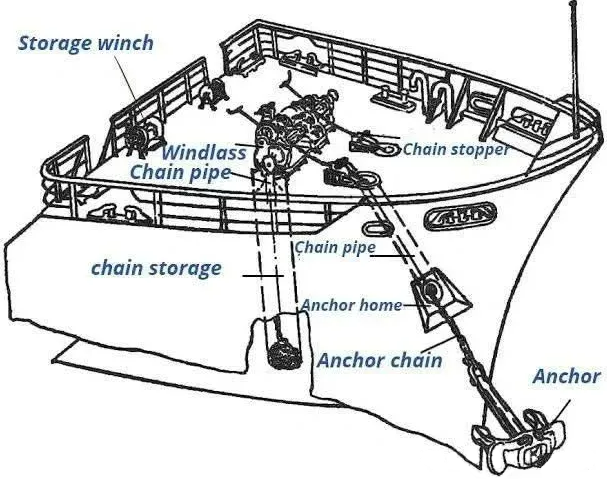
Anchor windlass: The core mechanical hub of a ship's safety system
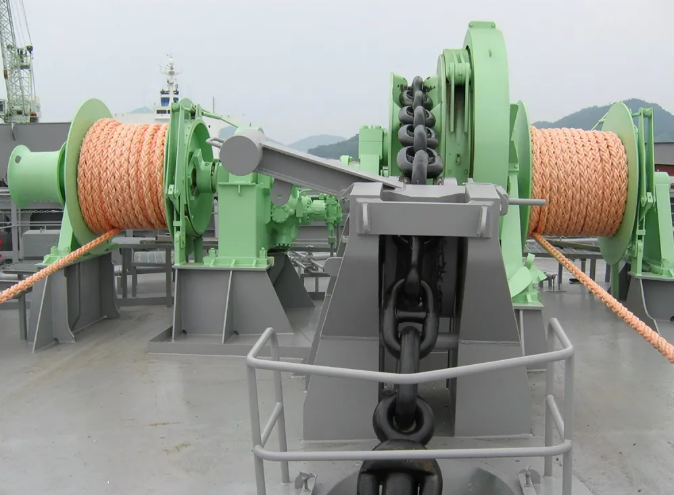
Anchor winches are far from ordinary heavy equipment; they are the nerve center of a ship's safety system. As a key device that uses mechanical power to raise and lower anchor chains, their performance directly determines a ship's maneuverability in anchorage, berthing, and emergency situations. Structurally, modern anchor winches typically consist of an electric motor/hydraulic drive unit, sprockets, a braking system, a clutch, and a control panel. Some ocean-going vessels are also equipped with independent emergency manual operation devices to ensure that anchoring operations can still be completed in the event of main power failure.
📌 Analysis of the Multidimensional Safety Value of Anchor Windlass Function
1. Core Technology of Anchor Equipment Control
- Precisely deploy and retract anchor chains
The variable frequency speed control system enables stepless speed control of the anchor chain from 0.5 to 9 meters per minute. During typhoon season mooring, the chain length can be precisely adjusted to the section (each section of the anchor chain has a standard length of 27.5 meters), avoiding insufficient mooring force due to manual operation errors.
- Deep-sea operation capability
Very large crude carriers (VLCCs) are equipped with heavy-duty anchor winches that can withstand tensile forces of over 2,000 kN, ensuring stable anchoring in waters up to 80 meters deep.
2. Multi-level safety protection design
- Mechanical braking system
The dual redundancy design of normally closed electromagnetic brake and manual belt brake allows for emergency braking within 0.3 seconds in the event of a sudden change in anchor chain load, preventing "anchor slippage" accidents.
- Overload protection device
When the anchor chain tension exceeds 110% of the rated value, the power is automatically cut off and an audible and visual alarm is triggered. In 2024, a container ship experienced a collapse of the anchor winch gearbox due to the failure of this device, which has been listed as an IMO safety alert.
3. Dynamic positioning auxiliary support
In DP2/DP3 class dynamically positioned vessels, the anchor winch and propulsion system form a closed-loop control: when the GPS positioning deviation exceeds 5 meters, the anchor winch automatically adjusts the anchor chain tension to help the vessel maintain its position. This has become a standard operating procedure in deep-sea oilfield operations in Brazil.
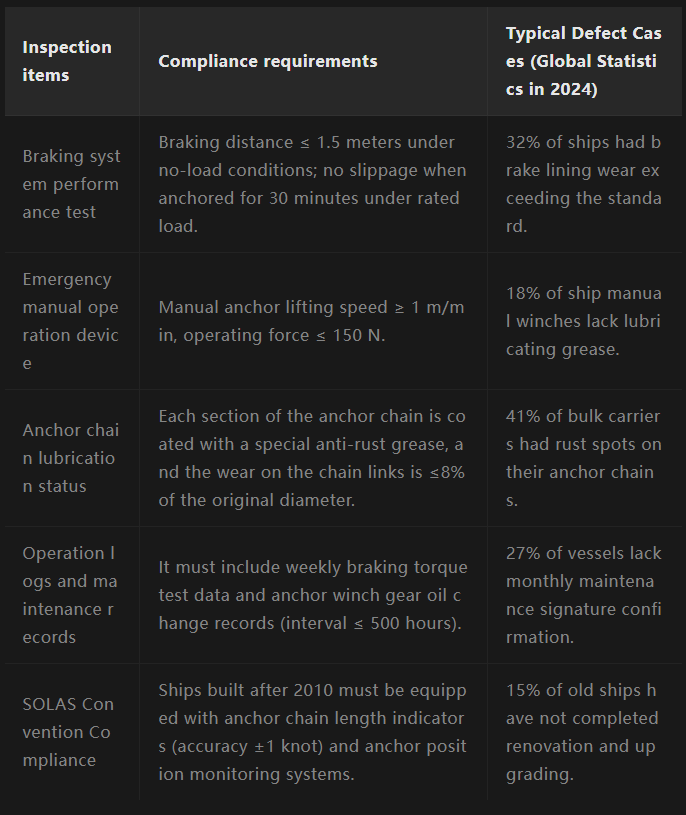
Key Compliance Points for Anchor Windlass Inspections (Latest Standards, 2025)
💡 The Practical Significance of Anchor Windlass Maintenance: Case Studies
- Accident involving a bulk carrier in Japanese waters in 2023
The anchor chain went out of control due to contamination of the anchor winch brake hydraulic oil, causing the vessel to drift and run aground in strong winds. It was eventually detained by the Japan Maritime Safety Administration (JMSA) for 14 days, resulting in a direct loss of US$1.2 million, and the shipowner was blacklisted by the Paris Memorandum.
- The 2024 IMO circular emphasized
Anchor winch failure ranks fourth among the causes of PSC stays (after life-saving equipment, fire protection systems, and navigation equipment), and 85% of stay cases are directly related to incomplete routine maintenance records.
🌐 Industry Best Practice Recommendations
- Preventive maintenance plan
Check the anchor winch base bolt torque on each voyage (recommended value: M30 bolt preload 560 N·m).
Change the brake fluid quarterly (ISO VG 46 anti-wear hydraulic fluid is recommended).
- Seafarer Operations Training
Anchor winch emergency operation drills are conducted every six months (simulating manual anchor lifting in the event of main power failure).
Certified crew members are required to be familiar with the mechanical schematics of anchor winches and troubleshoot common malfunctions (such as handling clutch slippage).
- Technology upgrade solution
Install a condition monitoring system (CMS) for anchor winch to monitor oil temperature, vibration levels, and chain tension in real time.
For vessels over 15 years old, consider upgrading the anchor winch electro-hydraulic system (energy efficiency improved by 25%).
The reliability of anchor winches is like a ship's "safe anchor point," underpinned by a deep integration of mechanical engineering, maritime regulations, and safety management. From anchoring in the ice-covered Arctic shipping lanes to typhoon-resistant operations in the equatorial waters, every precise anchor winch operation sets the safety baseline for modern navigation. As the International Council of Shipping (ICS) 2025 report states, "A compliant anchor winch system is not a cost item, but a risk hedging tool for ship operations." Let us use technical specifications as the foundation and maintenance responsibility as the guiding principle to firmly secure the safety line of every vessel.